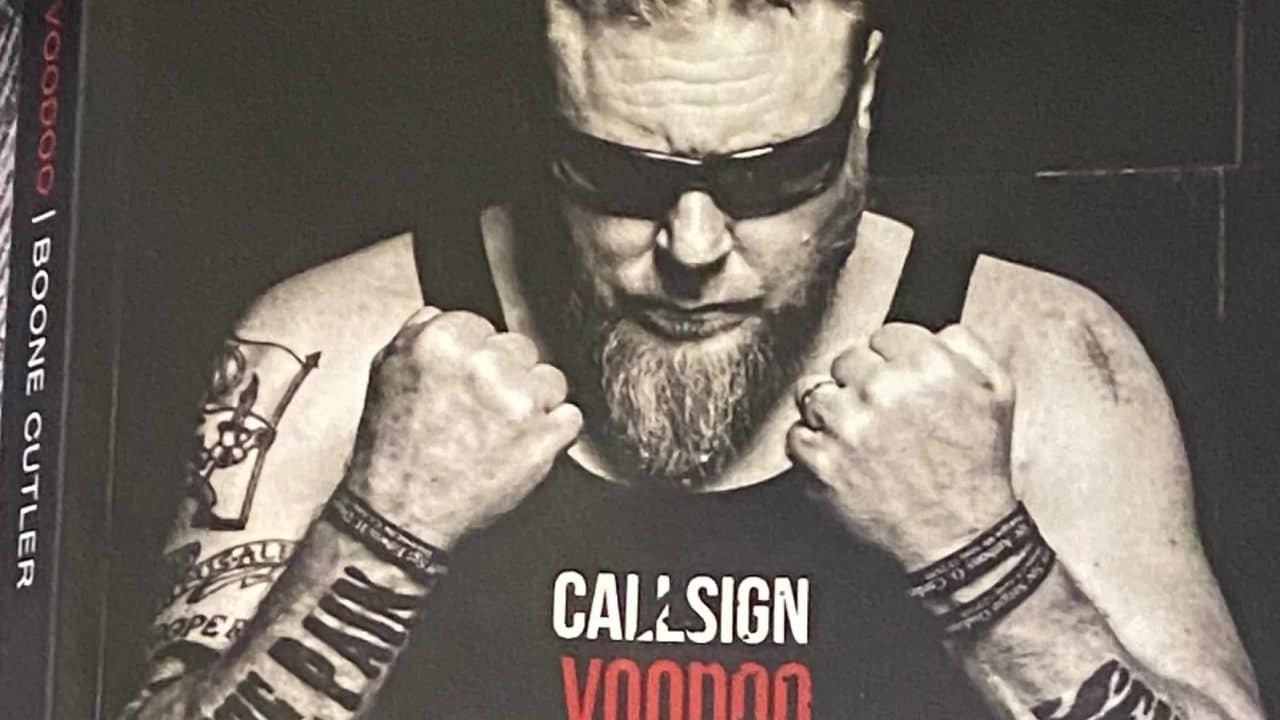
I recently had the honor of reading Boone’s book, “Callsign Voodoo.” This is my review:
Boone Cutler, an Army Combat Iraq War Veteran, is a respected voice of influence in the Warfighter Community. In his book, “Callsign Voodoo,” he shares riveting accounts of his first-hand experience and lessons learned while performing Psychological Operations, (PsyOp), in Sadr City, Iraq. At the core, one must understand how the word ‘radical’ (adj.), is best defined in context by the Cambridge Dictionary, as “believing or expressing the belief that there should be great or extreme social, economic, or political change.” This definition is the foundational motive that drives how one moves from an oppressive environment to freedom.
Boone’s ability to cognitively process and capture his thoughts on paper gives others a glimpse of events which took place on his watch. As he shares his thoughts and feelings revealing pain and brokenness, I can personally surmise we will never truly comprehend what these men and women experienced. We can only parallel our experiences through our personal life challenges. For anyone who has or continues to struggle with post-traumatic stress disorder, anxiety, depression, and panic attacks due to traumatic life experiences, this is challenging to read. Pace yourself. Every person is affected differently depending on the dynamics of the circumstances which led up to, during, and following the event or events. Sadly, those who survive the war, continue to battle the war within which may result in suicide. Think about it.
Some key insights he shares, in my opinion, stem from an overall failure to understand the Warfighters objective. A specific example comes from pg.135; pg.136 “Politics and peaceful means should always be completely exhausted before we unleash the dogs of war. All life is sacred, but there is a time for war. Iraq was in every way a just war… I put my men in harm’s way, and we were forced to allow the enemy to go unpunished for violence or potential violence against American forces and against the Iraqi people who couldn’t help themselves. There were people who tried to kill my men and had the means to do it. Not punishing them for those actions only condoned their behavior.”
Meanwhile, as our service men and women are deployed to hostile territories, another type of war surfaces on the home front when those who are not involved choose to criticize the actions of others who are involved. In the grand scheme of a politically charged environment, perceptions are skewed through deception resulting in a lost perspective. He shares, “Those who died in Iraq are all heroes, and I don’t care if they died in the heat of the battle, were blown up by an IED, or choked to death in the chow hall. The bottom line is that they were in Iraq, not at home, and those American Warfighters were in Iraq carrying a weapon on foreign soil to protect our home. If they were serving, they died doing a hero’s duty and deserve every honor that can be bestowed upon them. ‘Support the troops’ has become a buzz term for this war but expressing support for the troops (but not the mission) in my view is a cop-out. The majority of Warfighters who served in Iraq support the mission wholeheartedly, and who knows better than the Warfighters on the ground? Supporting the mission is the only way to support the troops.” Pg. 153
Warfighters are further challenged in their ability when they cannot properly assess an after action review once an operation has been carried out over fears of disciplinary actions. One of his teammates shares, “Whether a unit is involved in full-scale kinetic operations or a battalion commander is involved in extended, battle-focused, non-kinetic dialogue with a terrorist faction representative, the combat zone is a cheese grater. A soldier’s skills, wits, and efforts are pressed against the blade on one side. On the other side, the truth of his ability is distilled for everyone to witness. Mistakes will be made, but without the confidence and an environment that promotes learning from one’s own mistakes, those mistakes will be incorrectly assessed, and the proper adjustments won’t be made.” Pg. 170
He concludes his book with a look at the current mental health crisis facing our Warfighter veterans. There is worse yet an overall stigma which stings them for having endured such atrocities then returned home. Personally, as an Army veteran myself, I advocate for the Warfighter Community as I believe most have a deep desire within their hearts to be understood by others about the nature of their objective.
Let’s take a look at this harsh reality. Here is my personal take away in this regard. They sit alone, silently crying on the inside, attempting to be at peace with themselves for making personal sacrifices for the freedoms we have the comfort of knowing. So, how do we repay them? We torture them by failing to accept them back into our society. We run in fear by refusing to help employ them. We cut them out of family relations because we don’t understand how to love them. A mother or father cries, “My little boy didn’t come home.” We turn our heads, hoping the drugs they throw at them will get them through the day. Those who stand in fear of the mental health crisis facing our Warfighter veterans would do well to dig deep into their souls to find courage.
Let me challenge you to fight the good fight! There MUST be a better way. We have to admit we are neglecting to sit and listen to the lessons they have to share with us. To understand they are still on a mission. It is imperative to do our part in supporting them on this journey once they return home. Failure is not an option!
~ Paula Renee Morgan, US Army Aviation Veteran, Founder and President of Twin Rotors Mission

Leave a Reply